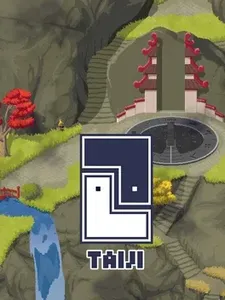
I completed Taiji (normal ending) in two sittings. I could write down a long list of nitpicks, but it's a solid puzzle game. So far I've preferred The Witness or Cipher Zero to it, but it's still well worth playing.
One thing I have to complain about though, is that the game has a terrible palette for its puzzles. The colors are straight up painful to make out from a distance. Deep blue vs. black dashes side by side? Light orange / dark orange / red in the same panel? Small gray pixels on white? Solid black tiles you can barely distinguish from petal outlines? 🥲 Zero option for zooming in?? 😭 Imo it's all kinds of visual wrong here. It's quite unfortunate.
[It turns out there was a zoom key mentioned in the control settings, but I failed to notice it. Also, my keyboard layout wasn't picked up properly, so hitting Z when I experimented early in the game didn't produce any result.]
(a few days later)
Got that last puzzle in Taiji. It was the only one I needed a hint for ("look at the mines raft again" was enough), otherwise I found 100%-ing the game occasionally demanding, but all in all rather straightforward.
It was a game of great highs but also annoying lows. The four main rulesets were fairly interesting and worked well together, and the other puzzle types provided nice breathers. I liked everything lateral the game threw at me. The music was both soft and stimulating. And the way each area is built is remarkable - I'd never expect so much variety from a top-down 2D world.
The lows though... As I said before, the colors are all over the place, and being unable to zoom in on grids while there's nearly no contrast between the glyphs and the background makes the experience of solving some panels needlessly painful. The color inconsistency actually extends beyond the panels and into the overworld - imo there's no strong visual consistency within any area or through the whole game - and it doesn't help that the area themselves are pretty distinct thematically. Overall, despite the peaceful eastern vibes, to me it's a place that felt very odd and often on the verge of breaking apart. Maybe this was intentional, I don't know. And maybe I'm asking too much, but the game could have been great in that regard, and it's frustrating that it misses the mark.
We talked a little about puzzle design earlier. Here are additional thoughts. I can confirm that, up to the late game, many puzzles have multiple solutions. It may be that Cipher Zero has less purely logical puzzles than Taiji, though the difference hasn't felt significant to me. However I agree that the standout parts are the one with puzzles relying on pure logic - if only because they take up more time to pick apart and solve. I have a big gripe with these puzzles though: very often they feel very arbitrary and don't explore anything particularly new or interesting.
Take these puzzles from the optional late game area:
The left one isn't difficult but it's a fun glyph pattern. To me it's like a witty story or a balanced melody. The right one though, it mostly feels like there was a distant idea about many-dots vs. few-dots, but the idea is diluted between three colors (white, black, blue) unequally balanced on the few-dots size, and then there were yellows thrown in to fill in the logical blanks. It doesn't look good. It's like reading Kant: there are sound arguments in there and it's built to cover most cases, but it's not a fun experience and certainly not aesthetically pleasing. Tbh I've asked myself more than once why I cared about solving these - overall I wanted to and I enjoyed it, don't get me wrong, but that feeling of arbitrariness was never very far.
And unfortunately (like the colors before), the inconsistency extends from one puzzle to the next. Sure, the puzzles in one area used one ruleset extensively, but I didn't get a sense of progress or exploration. Take the puzzle directly after the fun diagonal pattern one:
Does it relate with the previous puzzle in any way, beside having dots? I don't see it. And that's maybe why I enjoyed The Witness much more: most puzzle series were heavily curated and organized around clear ideas. There were slow ramp-ups, natural follow-ups, surprising betrayals, recontextualizations, even the odd troll puzzle. It's a rich puzzle language, which unfortunately I found Taiji mostly devoid of.
One last negative I want to mention is that I believe Taiji actually suffers from its open world. It's great for the clever environmentals near the end, but it plays against telling (cognitive) stories through puzzle series. And my first hour with the game was without doubt the most frustrating, as I kept stumbling on advanced puzzles I didn't have the tools to solve. I went to the waterfall, to the mansion, to the factory, to the tombs - every time I'd enter a new area, I was completely thrown off by an opaque panel. And the worst thing is that I didn't know whether they were the beginning of a tutorial (as you might expect from the first active puzzle you find in an area) or not.
Well, I had thoughts. 🙂
Fun facts: I never discovered the fast travel system. And I never understood the full rules for the first(!) puzzle type in the game.
It's a very good game, but it tries so much to emulate The Witness that when it falls short of something, I have a hard time not seeing it as a glaring mistake. And more recent games have shaped my expectations towards a richer, tighter puzzle design. But it's still a very good game. You should play it. 😄
(a few days later)
It looks like one main difference between [@OCWZJ and I] is that I got to Cipher Zero without much pen and paper puzzle experience nor expectations, and while I often enjoy these puzzles they can only carry my interest so far in video game form. In fact I can probably admit that the aesthetic aspects of a game can fill in some inconsistencies in gameplay, and this has carried my appreciation for CZ in no small measure.
I agree a few puzzles in CZ feel like they were just there to reveal a nice shape... but that was equally true of Taiji. CZ's puzzles were organized in sequences which imo were generally better built than Taiji's: within one, the puzzles kept to comparatively less symbols and had a much more suspenseful difficulty curve. I'm sorry to say that Taiji felt often quite flat in that regard, whereas I could often be sure that CZ's sequences would get markedly tougher near the end.
It's interesting that @KΔ would mention Filament, because on the spectrum of non-pure logic puzzles, I'd position CZ halfway through The Witness and Filament. (My observations here are admittedly based on feelings rather than scientific observations, but:) My experience of these three games felt similar in that they required straining the same parts of my brain until I made their rulesets/languages my own. The Witness is grid-based and eliminating some segments in the grid can quickly cascade into having very few options left. CZ is also grid-based but the consequences of the rules were overall less localized. And Filament, indeed, requires extensive effort for pruning solutions. Despite the game's attempts at progressive difficulty, I felt like I was hitting a wall for the first 10 hours or so of the game. Eventually though, it clicked, and I started applying heuristics I couldn't explain into words - or at least, heuristics that I didn't care to formulate consciously while solving the puzzles. And damn, that felt good. It's probably the equivalent of flow state for puzzles. This isn't something I generally expect nor require from a game - I do appreciate methodical, step-by-step pure logic too - but I'm thankful for any game that takes me there. And CZ hit that mark.


(copied over from the thinky games discord)
I completed Taiji (normal ending) in two sittings. I could write down a long list of nitpicks, but it's a solid puzzle game. So far I've preferred The Witness or Cipher Zero to it, but it's still well worth playing.
One thing I have to complain about though, is that the game has a terrible palette for its puzzles. The colors are straight up painful to make out from a distance. Deep blue vs. black dashes side by side? Light orange / dark orange / red in the same panel? Small gray pixels on white? Solid black tiles you can barely distinguish from petal outlines? 🥲 Zero option for zooming in?? 😭 Imo it's all kinds of visual wrong here. It's quite unfortunate.
[It turns out there was a zoom key mentioned in the control settings, but I failed to notice it. Also, my keyboard layout wasn't picked up properly, so hitting Z when I experimented early in the game didn't produce any result.]
(a few days later)
Got that last puzzle in Taiji. It was the only one I needed a hint for ("look at the mines raft again" was enough), otherwise I found 100%-ing the game occasionally demanding, but all in all rather straightforward.
It was a game of great highs but also annoying lows. The four main rulesets were fairly interesting and worked well together, and the other puzzle types provided nice breathers. I liked everything lateral the game threw at me. The music was both soft and stimulating. And the way each area is built is remarkable - I'd never expect so much variety from a top-down 2D world.
The lows though... As I said before, the colors are all over the place, and being unable to zoom in on grids while there's nearly no contrast between the glyphs and the background makes the experience of solving some panels needlessly painful. The color inconsistency actually extends beyond the panels and into the overworld - imo there's no strong visual consistency within any area or through the whole game - and it doesn't help that the area themselves are pretty distinct thematically. Overall, despite the peaceful eastern vibes, to me it's a place that felt very odd and often on the verge of breaking apart. Maybe this was intentional, I don't know. And maybe I'm asking too much, but the game could have been great in that regard, and it's frustrating that it misses the mark.
We talked a little about puzzle design earlier. Here are additional thoughts. I can confirm that, up to the late game, many puzzles have multiple solutions. It may be that Cipher Zero has less purely logical puzzles than Taiji, though the difference hasn't felt significant to me. However I agree that the standout parts are the one with puzzles relying on pure logic - if only because they take up more time to pick apart and solve. I have a big gripe with these puzzles though: very often they feel very arbitrary and don't explore anything particularly new or interesting.
Take these puzzles from the optional late game area:
The left one isn't difficult but it's a fun glyph pattern. To me it's like a witty story or a balanced melody. The right one though, it mostly feels like there was a distant idea about many-dots vs. few-dots, but the idea is diluted between three colors (white, black, blue) unequally balanced on the few-dots size, and then there were yellows thrown in to fill in the logical blanks. It doesn't look good. It's like reading Kant: there are sound arguments in there and it's built to cover most cases, but it's not a fun experience and certainly not aesthetically pleasing. Tbh I've asked myself more than once why I cared about solving these - overall I wanted to and I enjoyed it, don't get me wrong, but that feeling of arbitrariness was never very far.
And unfortunately (like the colors before), the inconsistency extends from one puzzle to the next. Sure, the puzzles in one area used one ruleset extensively, but I didn't get a sense of progress or exploration. Take the puzzle directly after the fun diagonal pattern one:
Does it relate with the previous puzzle in any way, beside having dots? I don't see it. And that's maybe why I enjoyed The Witness much more: most puzzle series were heavily curated and organized around clear ideas. There were slow ramp-ups, natural follow-ups, surprising betrayals, recontextualizations, even the odd troll puzzle. It's a rich puzzle language, which unfortunately I found Taiji mostly devoid of.
One last negative I want to mention is that I believe Taiji actually suffers from its open world. It's great for the clever environmentals near the end, but it plays against telling (cognitive) stories through puzzle series. And my first hour with the game was without doubt the most frustrating, as I kept stumbling on advanced puzzles I didn't have the tools to solve. I went to the waterfall, to the mansion, to the factory, to the tombs - every time I'd enter a new area, I was completely thrown off by an opaque panel. And the worst thing is that I didn't know whether they were the beginning of a tutorial (as you might expect from the first active puzzle you find in an area) or not.
Well, I had thoughts. 🙂
Fun facts: I never discovered the fast travel system. And I never understood the full rules for the first(!) puzzle type in the game.
It's a very good game, but it tries so much to emulate The Witness that when it falls short of something, I have a hard time not seeing it as a glaring mistake. And more recent games have shaped my expectations towards a richer, tighter puzzle design. But it's still a very good game. You should play it. 😄
(a few days later)
It looks like one main difference between [@OCWZJ and I] is that I got to Cipher Zero without much pen and paper puzzle experience nor expectations, and while I often enjoy these puzzles they can only carry my interest so far in video game form. In fact I can probably admit that the aesthetic aspects of a game can fill in some inconsistencies in gameplay, and this has carried my appreciation for CZ in no small measure.
I agree a few puzzles in CZ feel like they were just there to reveal a nice shape... but that was equally true of Taiji. CZ's puzzles were organized in sequences which imo were generally better built than Taiji's: within one, the puzzles kept to comparatively less symbols and had a much more suspenseful difficulty curve. I'm sorry to say that Taiji felt often quite flat in that regard, whereas I could often be sure that CZ's sequences would get markedly tougher near the end.
It's interesting that @KΔ would mention Filament, because on the spectrum of non-pure logic puzzles, I'd position CZ halfway through The Witness and Filament. (My observations here are admittedly based on feelings rather than scientific observations, but:) My experience of these three games felt similar in that they required straining the same parts of my brain until I made their rulesets/languages my own. The Witness is grid-based and eliminating some segments in the grid can quickly cascade into having very few options left. CZ is also grid-based but the consequences of the rules were overall less localized. And Filament, indeed, requires extensive effort for pruning solutions. Despite the game's attempts at progressive difficulty, I felt like I was hitting a wall for the first 10 hours or so of the game. Eventually though, it clicked, and I started applying heuristics I couldn't explain into words - or at least, heuristics that I didn't care to formulate consciously while solving the puzzles. And damn, that felt good. It's probably the equivalent of flow state for puzzles. This isn't something I generally expect nor require from a game - I do appreciate methodical, step-by-step pure logic too - but I'm thankful for any game that takes me there. And CZ hit that mark.